
'Lead, kindly light' - My recent night drive through the wilderness
A few weeks ago I found myself having to drive to Dunkeld via Crianlarich and Loch Tay, as dusk gave way to night. This unexpected detour is profound on so many levels.

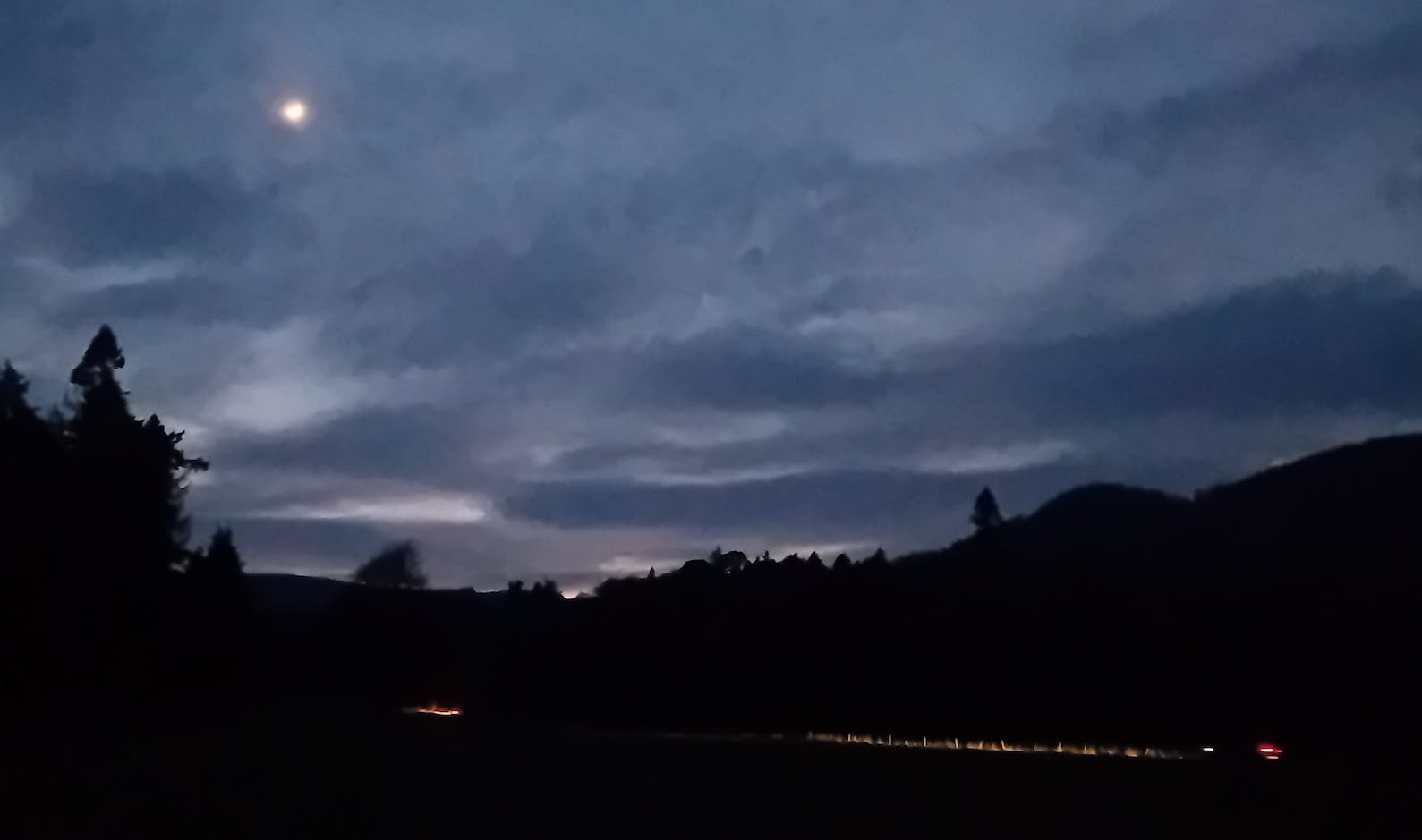
“And I said to the man who stood at the Gate of the Year, ‘Give me a light, that I may tread safely into the unknown.’ And he replied, ‘Go out into the darkness, and put your hand in that of God. That shall be better than light, and safer than a known way.’”
God Knows, Minnie Louise Haskins
I must warn the reader that this article takes a strongly religious tone, and will come across as esoteric, and even cultish in places. There will be several references to church sermons and theological writings. Many of you who have been kind enough to subscribe might come away feeling disturbed and alienated. Nevertheless, it is not my intention to (almost literally) preach to the choir. Second, this is a long and complex article, just like my recent car journey, which I will get round to describing below.
My previous Substack article concerns a strange interlude in my life when I was put out to pasture, almost on sabbatical. During my exile in the Camphill wilderness, not only had I been wrenched away from my home town and STEM aspirations, but I was daily whisked away from the house, from family, from people in general. Strangest of all, that security job with its weekend day shifts even diverted me from church attendance for several months. For a brief interlude, I was being honest to God.
There are times when we need to be put into storage. More often, however, we are required to live purposefully, observe the boundaries, rise to the occasion and go the extra mile, despite not seeing the final destination or reaping any immediate reward. This article concerns a recent incident when I had to take a necessary risk. It was one of those occasions which, as Pastor Sean Harris put it, thrusts someone into a difficult predicament, one which breaks down smug self-reliance and compels one to turn to the Almighty and say a quick prayer.
For the fortunate majority of us Westerners who are destined to live well past sixty, Life is a steady gradient. As we are carried along the time continuum, we ascend the hill and cast our eyes back across greater and greater distances, seeing milestones and circumstances from earlier years edge further away and become fainter. As we grow older we gain altitude, and see the segments of time (days, months, years, etc.), like hectares and acres shrinking down in the plain below.
I’m sure I said all that recently, but the core message here is that the life of a failed saint and fence-sitter is one of accumulating sorrow, that stratigraphy of lost years and missed opportunities, in front of which stands a yellow signpost with that agonising question: How much more successful and accomplished might my life have been, had I just obeyed the rules, never dilly-dallied, and fully subscribed to the Master’s agenda?
I write this not because I am some holier-than-thou. Far from it. As Leonard Ravenhill observed, too many churchgoers and even Bible College grads know the Word of God, but not the God of the Word. When I began my own forays into the four Gospels back in my youth, I quickly realised that Jesus was a strict teacher, who knew full well that most people listening to Him were emotionally attenuated fair-weathered creatures, too set in their own ways. ‘Their lips praise me, but their hearts are far from me.’
I have learned the hard way that a lukewarm churchgoer who puts on a saintly garb on Sundays and in public, and who caves into temptation behind closed doors and keeps putting off solemn duties including prayer and charity, not only is living two lives, but two OPPOSITE lives. And a physicist or chemist will tell you that two oppositely charged entities cancel each other out. The lukewarm life is nothingness. It equals no life at all. Giving a nod to the sneering atheist George Carlin, one might as well have spent all those priceless, irretrievable units of time in a coma. Years later, the half-washed pig becomes confronted by this epiphany, by a criminal record of wasted years, even wasted decades. Would that I had been either hot or cold! Better to have entirely rejected the faith, and spent all that time living in sin and being led by one’s own wisdom and inclinations, without any contrition and feeble pledges to clean up. Might it not have been better to have said to God twenty years ago, “No, thanks - just let me carry on living my life the way I like it, and I’ll get back to you when I’m older and more settled”?
When I was eight years old, I learned to ride a bicycle without stabilisers, and was taught to cycle safely on the roads by my father and older brother. As I improved my balance and my confidence grew, I became daring and frivolous. At one point, I deliberately cycled on the wrong side of a residential street, and my brother shouted, “Get back on the left side!” Cheekily, I tried cycling over the white painted lines in the middle of the road. My brother discredited my sly ‘halfway-house' tactic: “No, that’s even worse!”
A year later, figuratively, we came to a fork in the road. A group of us from our local church were bussed to a Billy Graham conference in Aberdeen, where my conscience was first awakened in an emotionally charged, irrational, unscientific manner. This was April 1991 - exactly thirty-five years ago. I shall write that again: Thirty-five years ago. Just months earlier, the Berlin Wall had been dismantled and Margaret Thatcher turfed out the back door. No Internet or mobile phones existed in my neighbourhood. Local councils still employed typing pools, and civil servants scribbled out memos using fountain pens. Back then I had never even seen a credit card.
And now, aeons later, here I am, still struggling with sin, as well as neglecting the ‘Do’s expected of ‘the new creation’. My brother, on the other hand, has been consistent. At eighteen he left school, left home and left the church - and he’s lived that way ever since. And not as some feckless addict or reprobate. Just like many other irreligious British adults, he and his wife are sober and self-disciplined. They don’t smoke, gamble, carouse or ‘do drugs’. Neither is promiscuous, abusive or lethargic. They work hard at their jobs, treat other people with courtesy, and strive hard to provide for and foster high moral values in their children. We know a great many non-Christians who’ve never stepped inside a church in their lives, who lead more righteous lives than some lifelong churchgoers. You are likely one of them.
As the controversial pastor Jim Standridge observed, “Don’t drink, don’t steal, don’t commit fornication, etc. - a heathen can obey all that!”
This month of April marks another two anniversaries. I was baptised exactly twenty years ago, long after hearing the late Billy Graham preach at Pittodrie stadium. (I attended a church which disapproved of infants and naive youngsters being baptised. Sadly, it is much harder to screen out spiritually perfidious or ill-prepared adults.) A few years earlier, in April 1999, I reluctantly tagged along with a group of Christian students and American evangelicals to a retreat in Kenmore beside Loch Tay. I recall vividly being in an uncharacteristically foul mood, not wanting to go, and being irritable and even impertinent during our stay. Looking back all these twenty-seven years later, it startles me that I had been ‘converted’ earlier that same decade. But I was the stony path, the shallow soil, the thorn bush. Quoting Standridge a second time, back in my adolescence I had some religious and spiritual aspirations, but “first I wanted my fun, fun, fun”. I was surrounded by peer pressures, entertainments, amusements, media, all manner of worldly low-hanging fruit. I wanted to sow my wild oats - go drinking, party, meet the girls, pass my education, land that well-paid job, get a car, move out, Live Love Life and all that - but, also have a toehold on the straight and narrow. Like King Herod Agrippa, I would periodically feel racked with guilt and self-loathing, and lend an ear to John the Baptist.
After all these lost years - ahem decades - I have come to acknowledge fully that the flawed mindset of low moral fibre, of too easily caving into temptation, has an equally egregious twin: the flawed mindset of being disinterested, ungrateful and neglectful about doing what is right. In some ways it is good that church attendance plummeted last century, in that a much higher percentage of the residual flock in today’s churches are serious about the faith, and adhere with the commandments. A great many people of my grandparents’ generation were dragged to church every Sunday, and sat in the wooden pews sullen and bored. As Ian Paisley put it:
“One of the great preachers said to me, ‘In some churches, if you brought a bucket of milk through the church hall, it would be ice cream by the time you reach the pulpit, [the congregation] are that cold.’
“Is that the sort of Christian you are!? You’re only playing at it! I have found in my Christian experience that if I am to do anything for God, or be anything for God, then I have to put my self, body, soul and spirit into it! …totally, absolutely, unconditionally, the whole lot for God!”
Having dithered and gone round in circles, I now fully get what the fiery reverend was alluding to. If one has to involuntarily devote one’s years to attending church, singing hymns, reading the Good ol’ Book, praying, staying chaste, and doing charitable works - then do them properly. I believe that the pig stunted by indecision and disinclination is little better than the unashamed pig doing rolly-pollies in its murky sins. Better to obey the rules, to shun the Don’ts and methodically act out the Do’s, even when it all seems tedious or pointless - and years later, look back on a life spent following the manual and reaping a harvest. I recall Willie Rushden on I’m Sorry I Haven’t a Clue completing that famous line of Shakespeare’s:
“To be or not to be…just BE!”
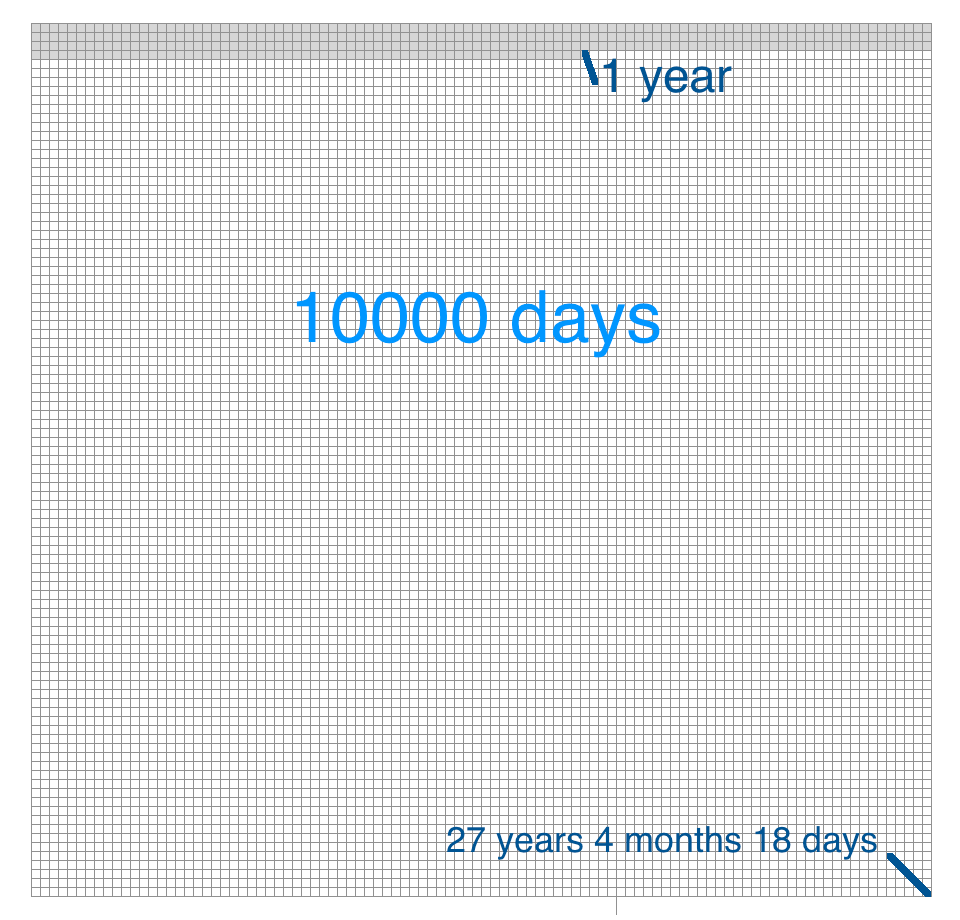
Did I say that our lives are short? Let me illustrate this graphically. Picture a 1 metre by 1 metre grid of 1cm squares. Imagine each square represents a day in your life, just like each square in a calendar. We know that one square metre consists of 10,000 square centimetres. And 10,000 days amounts to 27 years plus a few months. Two great squares equals slightly under 55 years. Three equals 82 years, about the average life span for a women here in the UK. The average man shall not live 30,000 days, not even here in ‘the West’. Not much, when you think about it.
That night drive through the mountains
“Fancy offering any self-respecting person security from the cradle to the grave! In society today most men do not experience enough challenge and hardship. How can people work off their frustrations by, e.g. kicking a ball in a tiny park?”
Wilfred Thesiger
During these past five years, ever since embarking on my cleaning career and escaping from the Ayrshire wilderness, I have been steadily sorting my life out, developing good habits, spending most of my time away from the home and the Internet, reading books in the evening, and going to a different church on my own accord. During the middle of last month, my parents were staying for a week at their timeshare in Dunkeld, just as they have these past eleven years. This is their well-earned retirement present for which they signed up in 2015, after nearly forty years of marriage, thirty years of child-rearing and paying off that mortgage, after attending to dying relatives, after many long years in the workplace. A present, to which my youngest sister and I have been privy, particularly in more recent times when we do much of the driving.
Just as I did last year, I drove my parents to Dunkeld, stayed a couple of days, and then returned home and to the workplace until Friday. Last year I travelled home and back by train. Sunday 8 March 2026 witnessed a conflagration which put out of commission all trains docking at Glasgow Central, and so this year I had to borrow the car. Finishing my shift on Friday, against maternal caution, I felt a strong moral compulsion to drive back to Dunkeld that same evening. I live a different life now, and I refuse to loiter around the house all alone.
However, the West Scottish transport network presents further problems to the traveller heading east. Much of the M8 is a roadworks nightmare. The roads around East Dumbartonshire were drawn on a seventeenth century map by a colony of slugs. The only reasonable route between Renfrewshire and Dunkeld is to drive up the A82 to Balloch, turn east, and follow the A811 road to Stirling before joining the A9 dual carrriageway. Shortly after 6pm, I locked up the house, stepped in the car, inserted my USB stick into the dashboard and turned the ignition. It was going to be a long journey (3 hours), so - as I have done many times in recent years - I had loaded some speeches and sermons onto the USB. (I know this might freak out some readers, but in recent years I have tuned into many a preacher and their sermons, in my repeated attempts to sort my life out.)
I was going to need these audio files. I managed to cross the Erskine Bridge without much difficulty, and was soon on the dual carriageway passing Dumbarton. At Balloch I turned off the roundabout and started heading east for the A811. I didn’t even cover half a mile before I was turned back. The police had cordoned off the road, and there was no other reasonable route heading east. Every Scottish driver knows there are no straight lines across the country. The M8 is a solid traffic jam and the Great Western Road into Glasgow isn’t much better. And now the A811 was blocked off. I had a straight choice: return home, or…drive to Dunkeld through the mountains. In the receding light, in early spring.
Unlike the narrow, twisting A73 road to Lanark (with its monster HGVs hurtling downhill at 60mph) along which I foolishly drove in October 2022, the A82 alongside Loch Lomond and the roads beside Loch Tay and via Aberfeldy are not unfamiliar territory. However, I had never driven through Breadalbane at night. Two and a half hours of driving along twisting mountain roads in pitch darkness awaited me. If the car broke down, I could be stranded all night. If a deer ran on the road and mounted the bonnet, I could die. I pulled the car to one side and said a quick prayer, before returning to the A82, and turning north.
Maintaining a graceful 50mph, I journeyed up the long twisty shore road hugging the full gamut of Loch Lomond in the receding twilight, between two columns of eerie jet black silhouetted mountains. By the time I passed through Ardlui and past the northern tip of the loch, the outside world was consumed in darkness. Driving through the Grampians at night can be a bewildering experience for the Lowlander. In the agricultural districts, the night driver will see a few distant lights from cottages and the faint glow of nearby towns. Outside the Central Belt galaxy, all is shrouded in inky blackness. I might as well have been driving through a long, unlit tunnel. Nothing to see but a dark beige strip of tarmac and even fainter, paler reflections of LED light bouncing off trees, rock faces and walls.
On the uphill approach to Crianlarich, I decided there was no turning back. Apprehension steadily gave way to acceptance, with a glimmer of hope. In time I reached that critical junction village and turned right, before heading east to Killin. It was around this point that I realised this detour was perhaps the right decision after all. There were few other vehicles, and therefore few piercing beams of LED light from oncoming traffic. The narrow, twisting single track naturally forced us few drivers to control our speed. Furthermore, the weather was remarkably benign that evening.
Eventually, I reached Killin and navigated my way through this strange, faintly illuminated agglomeration of streets and buildings, with the familiar surroundings completed blotted out by the night. It could have been a village in Dumfries and Galloway for all I knew. However, in time I was following the tight road hugging the north shore of Loch Tay beneath Ben Lawers, and approaching Kenmore.
As I traversed the narrow roads from Loch Lomond via Loch Tay and through Aberfeldy, I found myself traversing back in time as well as distance to Dunkeld. In the late 2000’s I explored the Trossachs and Loch Lomond, during and shortly after moving to Ayrshire and working at Camphill. The roads, towns and hills around Loch Tay were the haunts of my adolescence and early twenties, of Munro-bagging, of that retreat with Student Impact, of visiting Glen Lyon in 2006 when I was a recently baptised carnal Christian grappling with temptation. Aberfeldy and Strathtay were the haunts of mid-childhood when we started going on family vacations. We stayed in a lodge in Logierait in spring 1992, a year after that Billy Graham conference.
The roads were tattooed with the corpses of splattered small mammals. I must have driven over hundreds of them that Friday evening. Which got me thinking about the hundreds of ‘digital ghosts’ I had viewed online back in my twenties, all those damaged, broken, violated young females, about whom I knew absolutely nothing, their innocence mowed down without any Internet surfers noticing. Or representing the thousands of days spent and wasted as a whole, swallowed up by indecision, boredom, quiet insubordination, and ingratitude. A favourite Bible passage among radical preachers is Romans 1: They glorified not God nor gave Him thanks…therefore God handed them over to a reprobate mind. In his scathing commentary on Andrew Tate, John Collins (brought up a Catholic in Rochdale) made a crude observation: God is the god of ‘s— happens’. If we prefer to go our own way, God usually will let us bark up that wrong tree before facing the terrible, entirely self-perpetuated consequences.
As mentioned, I had loaded two sermons on my USB that evening:
The first was a sermon by AW Tozer, Unity that Brings Revival, touching on that elusive holy grail which is the talk in church circles - the magic intervention, dramatic ‘born again’ transformation, the ‘pouring of The Spirit’ upon a mass of worshippers sending them into a trance and immunising them against temptation and sin. Which occasionally happens. Some very wayward, irreligious, vile individuals have been radically transformed into saints overnight. One particular example is the Cornish preacher Billy Bragg two centuries ago, a tin miner and violent drunkard, who was dramatically converted one night, and turned into an entirely different person. He spent the rest of his life being civil, polite, industrious, and so committed to serving God that he spent the rest of his life building churches and leading open-air worship. However, as Tozer pointed out, too often we place the cart before the horse. We believe that God will magically show up like a genie and make us better people, and a united people at that. In truth, in order for God to enter the equation, we must first clean up our act and settle our differences. To use Tozer’s analogy, a building might be supplied with electricity of many amps and hundreds of volts…but leave the switch off, and it powers nothing.
The second, longer sermon, which helped me focus on the road from Ardlui to Killin, was delivered by Jon Courson, Talking Cross, or the Cross Talking, which focused on what seemed a disproportionate punishment meted out by God on Moses after he lost his temper with the Israelites in the desert. Courson’s main argument is that Moses had for years been suppressing feelings of anger and impatience after leading the stubborn, complaining people, after seeing them turn to sin and disobey God’s commands time and time again. Finally, Moses’ ire erupted when God ordered him to strike a rock and bring out water following yet more grumbling among the people. And for lashing out, Moses was punished: he would die in the desert, and never set foot in the Promised Land. A bit extreme? But Moses not only had spent too long hiding his true feelings from the people; he let his true feelings get in the way of his service to God.
As Courson put it, Moses “needed heart surgery”. I certainly have throughout the years. I needed heart surgery during my high school and student years when I reluctantly sat in the pew and went through the motions each Sunday, before reverting to type by Monday, content to live on my own terms and chase low-hanging fruit. It is easy to sympathise with the exasperated Moses, whose Hebrew flock repeatedly sinned, repeatedly complained, seldom were trustful or obedient, and even made God furious. They drifted aimlessly in the desert for forty years. My tally isn’t far short.
As we all know, the patient who is prescribed medicine, but who for some reason chooses not to follow the instructions to the letter, should not be left surprised by the continuation of the present, and should not expect a rapid diminution of symptoms. To the counterfeit Christian, Christianity and Christ are counterfeit. To the sullen backslider and church-quitter, to the shallow unrepentant Sunday Christian as much as to the agnostic and the atheist, God is little more than make-believe. I have learned the very slow and depressing way that in order to believe, we have to make.
As Jentezen Franklin explained in his sermon on fasting and prayer, God demands a physical effort on our part, an active putting up of barriers to temptation, an active commitment to hitherto meaningless rituals, before the incorporeal component completes the reaction.
As the charismatic Paul Washer articulated at great length in his epic youth sermon back in 2002 (something I stumbled across two decades later, which I dearly wished I had heard back then), too many ‘carnal Christian’ churchgoers claim to be ‘saved’ because they ‘stuck their hand up in the air’. As many a preacher has said in all these church services I’ve attended over the years, God is not some magician or hypnotist. It is not enough to walk through the narrow gate; we must then trudge the narrow way. As Willie Wright, my church minister in my early childhood warned [sic], “It’s not enough to be saved: you must stay saved.” This is where the rubber meets the road, as indicated in a recent Youtube podcast:
“A dream is not a living organism - it is an inert blueprint, and a blueprint has zero energy of its own. It cannot exert force on the world. The only way the lines on that paper become a house is through immense, sustained effort… Sweating in the sun is the only way it gets done.” D Education (‘English Podcast Conversation’ episode 69)
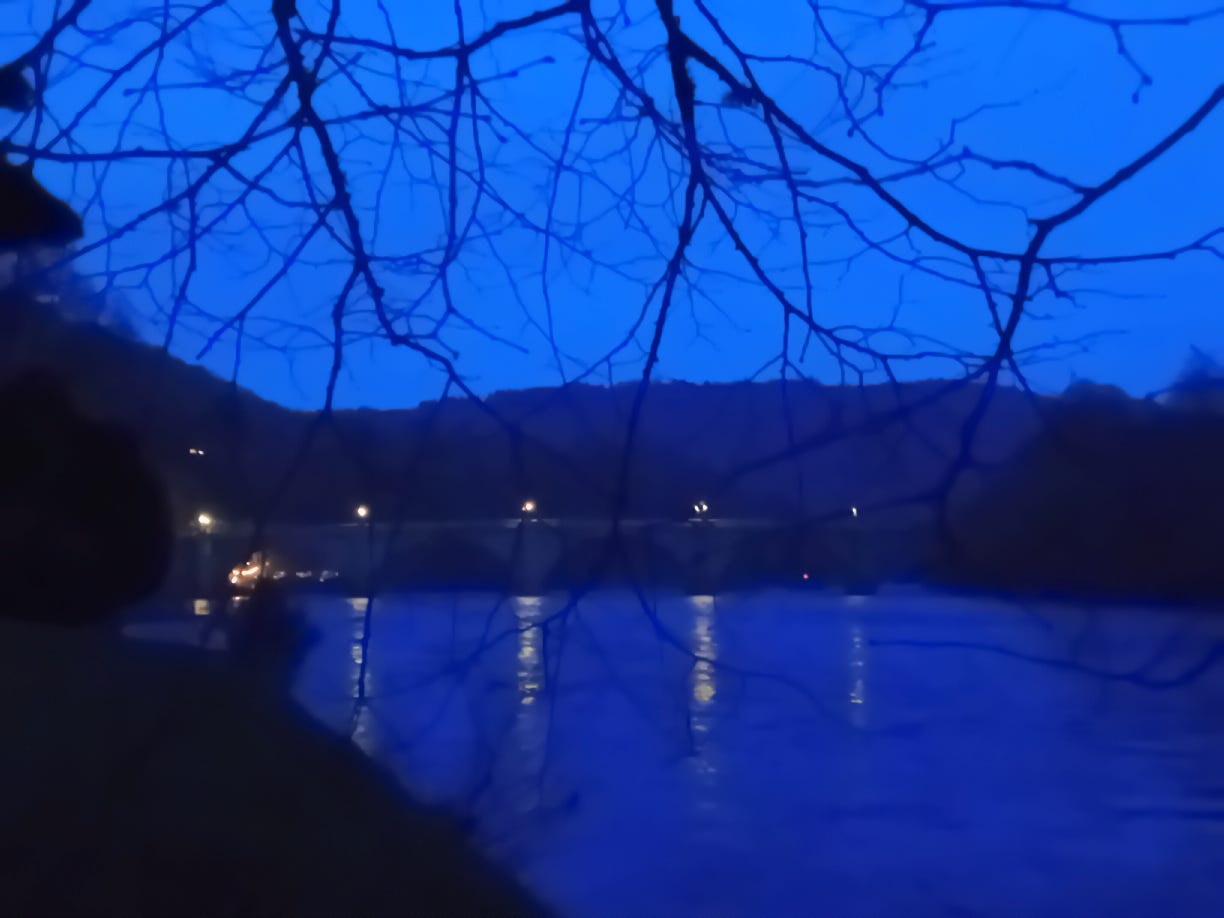
By the time I heard Pastor Courson say ‘Amen’, I was approaching Kenmore of all places, through the dense managed forest hugging the north shoreline of Loch Tay. I had been driving for over two hours, but still had at least another hour and a good few miles of twisting roads and Aberfeldy to cross. It was with a degree of sadness that I passed through the dimly illuminated town of Kenmore, for reasons which I need not fathom. Nearly ten thousand of them. By then, my USB was playing audio tracks featuring the Glasgow Orpheus Choir, a favourite of my late grandmother. She too loved sacred music, but struggled in the faith and could not pierce the veil beyond the ‘bells and smells’, the church politics and social cliques.
By the time I reached Aberfeldy, I was on the home stretch. Still, I decided to pull off the main road and notify my parents, not least because it was approaching 9pm and I was at least half an hour away. I could hear my mother’s astonishment in the long pauses between her words. “You’re in…Aberfeldy?” Which meant only one thing: I had driven nearly 100 miles through the mountains. This is often the way of the devout Christian: consult, discuss and pray with other people by all means, but don’t ask for their permission. David Wilkerson, who preached to gangsters and drug addicts in New York in the 1960’s, knew this well:
“Go out on a limb. Go so far that you can neither turn back nor escape…Tell yourself, the world and God that you’re going to burn all your bridges behind you.”
It was not until I crossed the River Tay five miles east of Aberfeldy that I spotted the first sure sign of Dunkeld - a local Stagecoach bus going to Perth. The A9 was only a few miles away. In time, I passed through Logierait, where I caught sight of the first road sign mentioning Dunkeld. By now it was approaching 9:30pm and tiredness was setting in. I let the audio files on the USB complete their course, and drove down the A9 and then along the narrow forest road to Dunkeld in silence. Again, I was following a tarmac thread dimly illuminated by the LED headlamps, the road rising and falling, meandering for miles. And then suddenly, I turned a corner, and into Dunkeld. The turnoff for the lodges, first on the right. Like a dream, my ambitious trek through the mountains ended.
The moral baseline
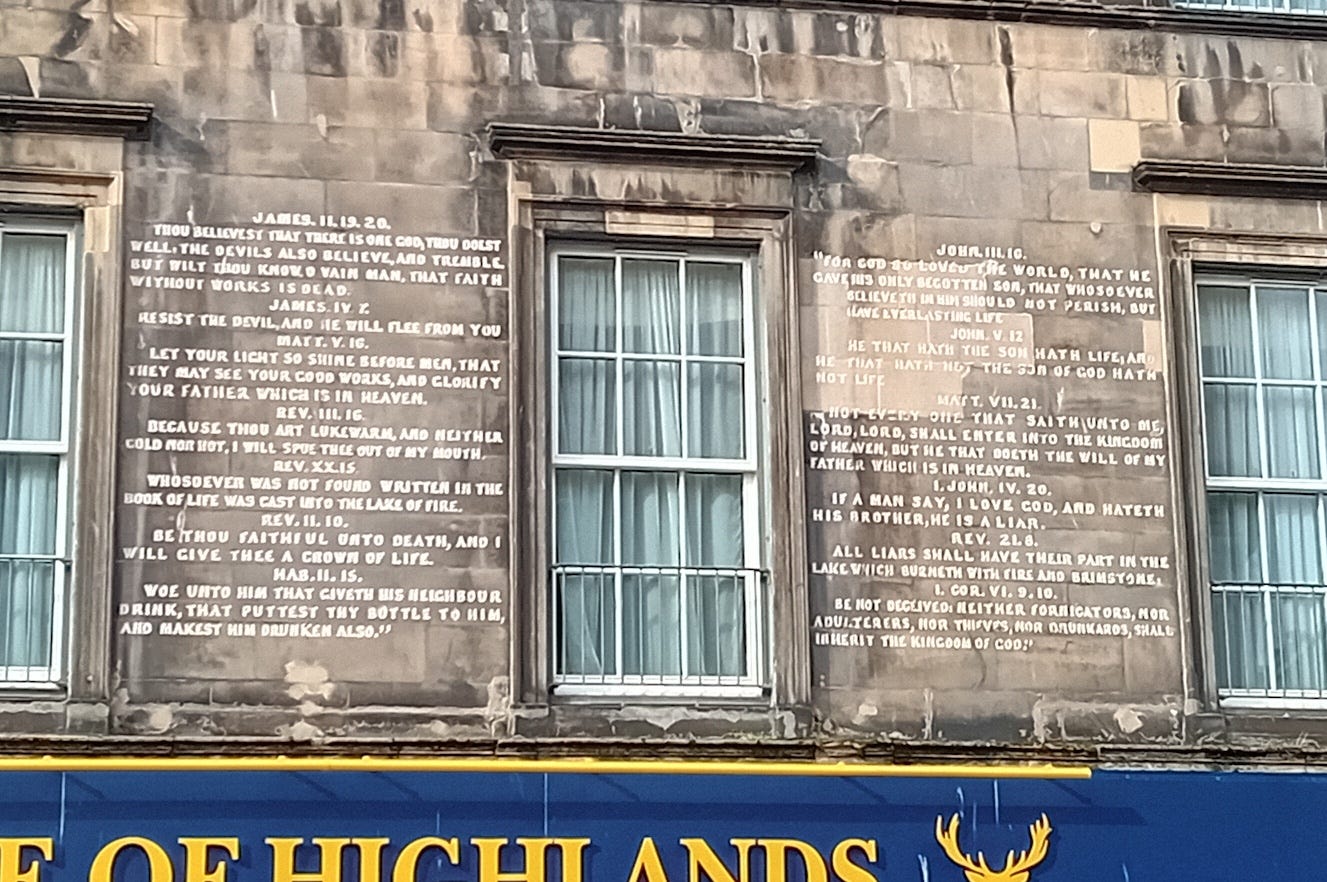
As some of you subscribers know, I like to pivot my arguments on and structure my writings with choice quotations. Well, here is a fabulous citation if ever there was one. (I apologise if the photograph is grainy - you may need to zoom in.) Almost every time my parents and I have stayed at the lodge in Dunkeld these past eleven years, we have paid a visit to Inverness. Halfway down the High Street, etched into the masonry above the House of Highlands shop, are some verses of Scripture which, although in archaic English, make abundantly clear the behaviours and qualities of a person which render them eligible or ineligible for admission to Heaven after they die.
As indicated by D Education, when it comes to actively abstaining from bad and doing what is good, the choice is entirely our own. A teacher or preacher can shout out the rules a thousand times, and some idiots like me will still fail, will keep choosing to go off in the wrong direction, will keep clinging onto worldly idols and familiar thought patterns.
My trajectory these past thirty-five years has been shameful, but I humbly acknowledge that my conduct could have been far worse. I dread to think how I might have turned out in my teens and twenties had St Andrews Baptist Church not punctuated my every week, steering my mind away from that poisonous box in the livingroom with lurid late night movies, and later that poisonous box in the dining room with the Internet browser. Admittedly, all those years spent revising for exams in high school, completing projects and revising for exams at university, and toiling for long hours in summer jobs kept me suitably distracted. I dread to think how far worse I might have turned out during my thirties, underemployed and unemployed, were it not for Brisbane Evangelical Church in Largs, all these nervewracking sessions in the church audio room, which thrust me into the spotlight and made me turn to God time and time again - and in doing so, examining myself, thinking twice. I would even go as far as to say that Student Impact with its austere theological atmosphere and fanatical teetotallers placed a safety net as I was chasing the adolescent student dream, when many GU students around me hurtled into a life of drinking, partying, sleeping around, failing exams and dropping out.
How many men today are languishing in jail or in drug rehab rooms, who didn’t receive the memo back in their youth? As the preacher Charles Lawson asked in his sermon on damnation, how many criminals, how many killers, gangsters and rapists, would have thought twice, might have stepped back from the brink, had someone pointed out to them the rules and the consequences?
As I have grown older, as the years have slowly swirled down the drain, I realise that my agnostic brother, and perhaps the majority of mostly irreligious fellow British subjects, is cognisant something of which I have been too obstinate, wilfully lazy, even too proud, to acknowledge: good habits and a clean conscience must be cultivated, not least because they are the hallmarks of someone who serves the Good Shepherd. And the best way is to start out when you are young, as advised by Michael Griffiths in his books to young would-be missionaries. It is the easiest thing in the world to be a wolf mingling with the sheep, to tag along to church, to speak magic formulae, and in the process delude yourself into thinking that you’re doing the right thing. As pointed out by Paul Washer, too many American churchgoers are morally and materialistically indistinguishable from the rest of society. They go to Sunday service, then return home to watch trashy TV, strut around in scanty immoral attire, drink, cuss, sleep around, and feed their bodily and sensual appetites.
It is not enough to say we ‘believe’ - as is inscribed in the High Street in Inverness, even the demons believe. It is not enough merely to attend church, to say prayers and read the Bible. Nevertheless, these things form a baseline. They are safety barriers and electrified wire which make the impulsive, wayward animal stop and think. Today, we need these spooky church buildings, these strange services, these dusty old Bibles and hymnary books, these tracts, these sermons, more than ever.
It is not enough to perform good works and abstain from bad - any heathen is capable of being morally upright and altruistic. We must do the boring things, go through the silly rituals, even when we cannot see the bigger picture. As Ravenhill and Spurgeon said, our faith and daily conduct depend on our prayer life. Prayer works, but not as a slot machine. Bible reading - yes, reading the whole of it - might save you from addiction, from prison, from destroying another person’s life.
About a decade ago I started reading the Bible from cover to cover across the calendar year. Like the first flurries of snow flakes, many thousands melt upon contact with the wet ground before a thin white layer begins to coalesce. I scan my way through at least a few dozen verses per day, and most do not immediately sink in. But every now and then, I am struck by a passage or throwaway phrase. A gun shot is fired in the air, and this dim, dozing farm animal jolts and stands to attention. It is the same with our behaviours, our daily habits. But we must be more than donkeys that have to be tied and dragged by the bit.
My progress as ever has been slow, but during the past five years I have slowly evolved and reformed. I now attend a different church alone. I read the Bible daily without any external inducement. I cap my evenings by reading great old books, listen to sacred music at times during my cleaning shifts, and take long walks whilst listening to morally uplifting speeches and sermons. After many long years of failing to see the point in praying, I now pray regularly for family and work colleagues - although there is far more to prayer than petition, and so I still have a long way to go.
To pass through the Narrow Gate involves veering off familiar terrain, firmly renouncing those little sins and creature comforts, applying strange new modes, and following a strange new trajectory, one seemingly illogical, even unsafe - just like that night drive.
Wonderfully written, Malcolm
great piece!